
Sale City Court Docket Searches
The Sale City Municipal Court page reads like a brochure. It holds no docket search. Pull out the citation, summons, or notice first. Check that Sale City is the court named on it. Write down the number, the cited name, the issue date, and the agency, then call the city at 229-336-7885 for the right court contact and current procedure.
- Read the document for the court and issuing agency.
- Record the citation or case number exactly.
- Call Sale City and ask for the municipal court record custodian.
- Confirm the present date, status, appearance rule, and copy method.
- Use a county office only when the notice or case type identifies that venue.
Sale City offers no vendor form. Georgia has no central citation database either, so calling the court directly is the reliable route, not a backup plan.
Sale City Court's Published Role
Sale City describes its Municipal Court as fair and impartial. It adjudicates applicable state laws and local ordinances. That confirms a real judicial function. What it does not publish is a judge's name, a clerk, annual case counts, a fee schedule, or any calendar archive. Treat those as gaps until the city fills them in. The official court source lays out the court's stated role.
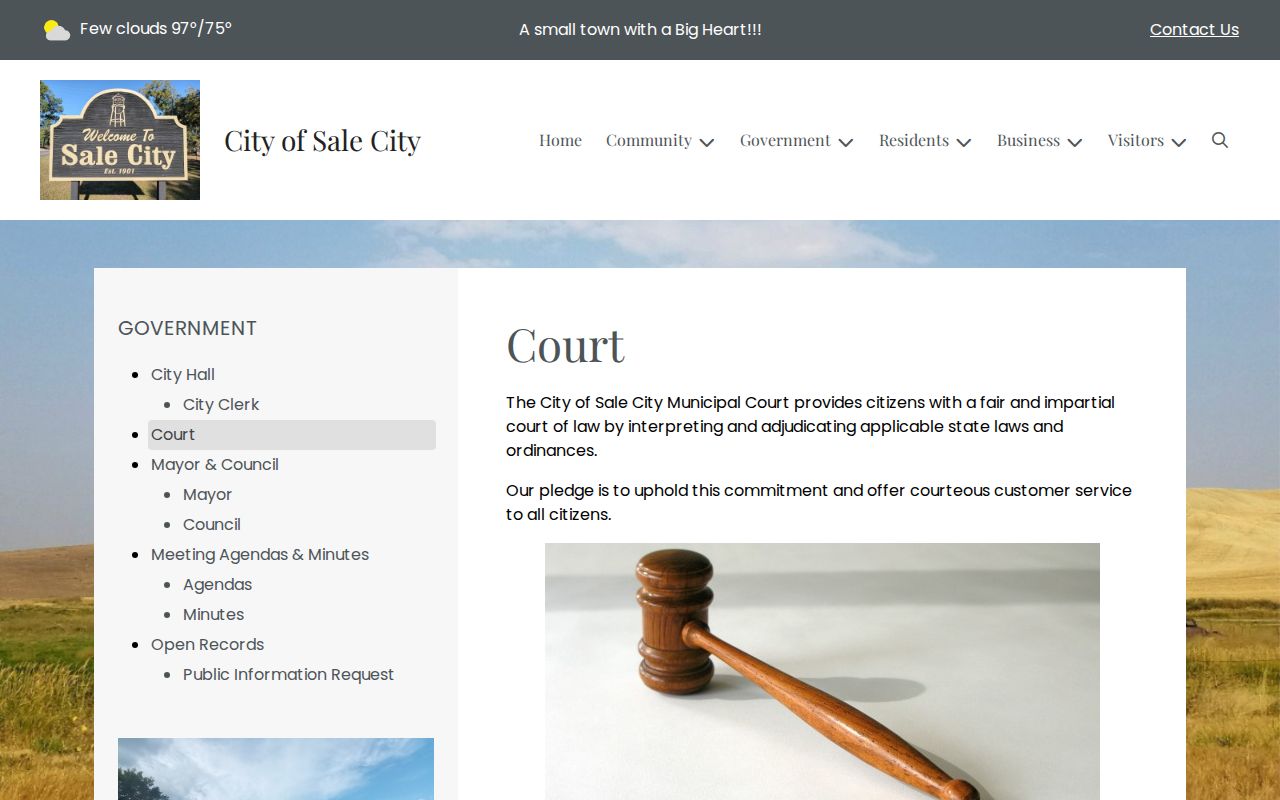
The page confirms the venue and where to reach city hall. Actual docket entries still take a direct request.
Inside the Sale City Municipal Court
A municipal court handles city ordinances and applicable state-law violations inside its own authority. It does not absorb everything that starts in Sale City. A felony, major civil action, or domestic-relations case belongs in Superior Court. Other matters may fall to State, Magistrate, Probate, or Juvenile Court. City Hall sits at 122 E Broad Street, Sale City, Georgia 31784. The phone is 229-336-7885. Hours run Monday through Friday from 9 a.m. to 5 p.m. Call first to learn which staff member keeps the judicial file. Ask whether the record can be inspected or copied.
Sale City's Court Page Is Static
Look closely at the court page and you'll find no case-number field, no name or date-of-birth field, no citation search, no calendar, no payment control, and no login. The city's separate payment links cover utility and vendor bills only, so don't mistake them for court-payment links. Paying a utility account tells you nothing about a Sale City citation.
No local citation vendor is listed. Confirm any payment website with Sale City Municipal Court before entering case details or submitting funds.
A static page can still tell you the venue and the office to call. It cannot show the chronological docket, the current hearing, a plea, an order, or a disposition.
Finding Sale City Court Dates
Use the printed citation as your starting point, then call the city to confirm it. A reset or later notice can replace the date on the paper. Ask what the time slot actually is. It could be a shared docket call, a plea setting, a trial, or something else. Sale City keeps no public calendar archive.
| Date | The latest date confirmed by the municipal court custodian. |
|---|---|
| Time | The report time or docket-call time, not an assumed individual slot. |
| Location | The place stated by the city or court notice. |
| Judge | The assigned judicial officer; no current name appears on the city court page. |
| Setting Type | An appearance, plea, hearing, trial, or compliance event. |
Missed a setting? Call the court right away. Don't count on an online payment to fix it, because Sale City publishes no verified court payment portal.
Sale City's Written Request Route
Sale City publishes a Public Information Request route. It goes to City Clerk Geraldine Bond at 122 E Broad Avenue. Hand-deliver or mail the request; the city also accepts written email, fax, or letter. For a judicial record, name the Municipal Court. Ask that it reach the court custodian rather than landing in the general city-records pile. Spell out the cited name, citation or case number, approximate date, issuing agency, and the exact item wanted, and say whether you want inspection, a plain copy, or certification. Ask about charges and timing too. Sale City posts no judicial fee schedule.
Sale City Traffic Ticket Lookups
A Sale City ticket search follows whichever court issued the ticket. The Georgia Courts ticket page warns that no centralized database covers all citations. It also notes that online availability can take 7 to 21 business days. Sale City has named no vendor. So the statewide notice creates no local online form for a citation lookup. Paying a ticket and contesting it carry different legal effects. Sale City publishes no deferred-disposition terms, no defensive-driving dismissal, no fine schedule, and no convenience charge. Confirm your appearance duty and what payment means with the court directly. For the wider venue map, see Mitchell County traffic court records.
Sale City Clerk and Court Custodian
Geraldine Bond is the named city clerk for public-information requests. Her published route is a sound starting point. It doesn't mean every judicial function rides through the general city-records process. A court docket is a judicial record. Your request should name the court and ask who keeps its file.
| Request | Best starting route | What to say |
|---|---|---|
| Municipal docket | City phone or written request | Name the court and case |
| Ordinary city record | City Clerk Geraldine Bond | Name the city department and item |
| County case | Correct Mitchell court clerk | Name State, Superior, Magistrate, or Probate |
That distinction keeps a judicial request from being handled as a broad sweep of city administrative files.
How Sale City Cases Reach the County
Sale City Municipal Court stays a local, limited-jurisdiction venue. Felonies and major civil or domestic matters route to Mitchell Superior Court. Misdemeanors and broad concurrent civil cases may sit in State Court, while Magistrate handles small claims, dispossessories, garnishments, and warrants. Whatever court has the filing controls access.
Docket flow: Sale City Municipal Court › Mitchell County Courts › Georgia Superior Court
Georgia E-Access sends Mitchell State and Superior users to PeachCourt, which requires an account. A city citation shouldn't be assumed to show up there. For county-level access, the Mitchell County court docket overview covers it at the right depth.
Sale City Docket Context
Sale City counted 354 residents in the 2020 Census. That makes it the smallest of Mitchell County's four incorporated cities. The figure says nothing about court work, though. No annual caseload number exists for the municipal court, so population cannot tell you how busy the docket is or how fast records move. Treat it as context, nothing more. The Sale City civic homepage shows the city's own description of its government and services.

That page confirms city contact details. For a court file, the route still runs through the municipal court itself.
Writing a Sale City Request
Keep the written request tight and exact. Name Sale City Municipal Court. Then list the citation or case number, the cited name, the approximate year, and the record you want. Say plainly what you want. It could be the docket sheet, the current setting, a disposition, an order, or a certified copy. Leave out personal details the court has not asked for.
- Docket
- The running record of filed events and court settings.
- Calendar
- A list of matters set for a date, not the full history.
- Disposition
- The entered result or current resolved status.
- Sealed
- Access limited by law or a court order.
Sale City does accept written requests for public information. Confirm with the court, though, which route covers its judicial file. Ask also whether certified copies are offered there.
Sale City Public Information Channel
For local detail, the city's written-request instructions lay out the most complete records channel Sale City publishes.
Those instructions cover city information. Requests go by hand, mail, email, fax, or letter. A judicial request still stands apart. It must name the municipal court as the holder of the file.
Do not assume a three-day response or 25-cent paper copies for court records. Those Open Records Act rules bind agencies. Judicial copying may follow different terms.
Who Can See Sale City Court Records
Georgia treats court records as generally public. Limits come from judicial procedure, privacy rules, and sealing orders. The Attorney General's Open Government FAQ explains this. It shows how court records differ from ordinary agency requests. Sale City's written route is a helpful starting point. Still, the municipal court itself decides access to its judicial file.
Key Rules:
Georgia municipal court information links the rules for city courts.
Uniform Superior Court Rule 21 sets public-access and sealing standards for Superior Court.
Georgia judicial security guidance covers restriction of certain judicial personal information.
Some material stays closed. Sealed files, juvenile matters, and protected identifiers can be withheld or redacted. Before relying on any copy, confirm fees, certification, and delivery with the office that actually holds the record.
Sale City Court Copy Checks
Tell the city how to reach you. A mailing address, email, or phone number belongs in the request. Ask for a cost estimate before copies are run. Sale City publishes no judicial copy fee. So general agency fee rules should not be applied to a court file by default.
Older records need more detail. Give the approximate year and the office that issued the record. Ask whether it still sits at the municipal office or has moved to an archive. No retention cutoff or archive index is published. Even at one address, city records and judicial dockets can rest with different custodians. Name Sale City Municipal Court each time.
A public docket can show that an event happened without supplying every paper behind it. If an order or plea appears on the docket, no copy may come with it. Ask for that item by name. A thin response may mean redaction, not a sealed case. Request whatever remains public and file the response with your record.